Mortar and Pestle or Small Blender for a Herb Paste?
A mortar and pestle or small blender for herb paste gives different control, texture and cleanup; choose the tool that suits your leaves and dish.
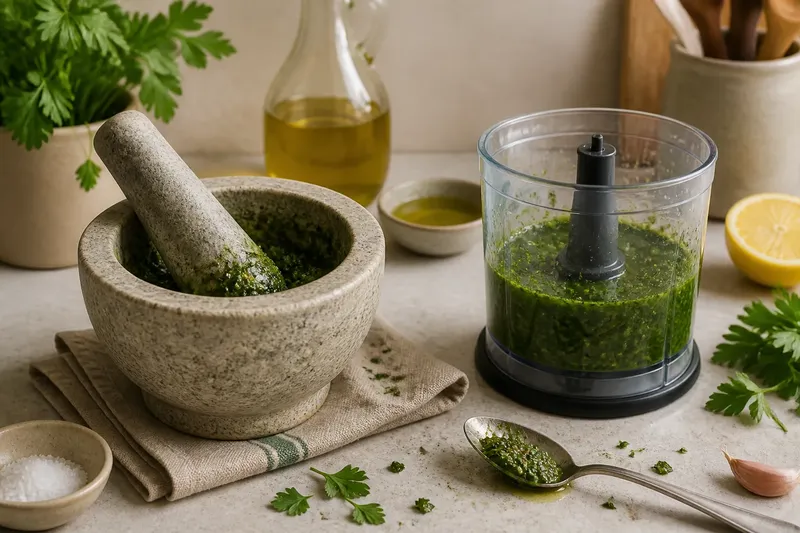
The most common mistake with herb paste is choosing a tool by convenience alone: a small blender can turn a handful of soft leaves into a wet, uniform smear, while a mortar can leave tough stems and uneven pieces if you stop too soon. For a mortar and pestle or small blender for herb paste, the better choice depends on the texture you want, the amount you are making and how much control matters.
Both tools break plant tissue and release aroma, but they do it differently. A pestle crushes leaves against a bowl, letting you work gradually. A blender’s moving blade chops rapidly, and its container tends to work best when there is enough material to circulate. Those differences shape the paste as much as the ingredients do.
What does each tool do to the herbs?
In a mortar, pressure and friction bruise and tear leaves against a rough or smooth bowl. You can feel the change under the pestle: intact leaves become a fragrant, damp mass, then a paste with visible flecks. The pace is slow enough to stop as soon as the texture suits the dish.
A small blender cuts the leaves into pieces with a spinning blade. The result is often more even, especially when the herbs are chopped first and a little oil or another liquid helps them move. But a blade can also make a thin, finely chopped mixture before the leaves have become a cohesive paste.
Neither texture is automatically better. A coarse paste can give a spoonful of sauce a leafy bite; a smooth one can spread easily over vegetables or coat pasta evenly. Decide whether the herbs should remain noticeable or disappear into the seasoning.
When is a mortar the better choice?
Choose a mortar when you want close control over a small quantity and prefer to build the paste in stages. It is particularly handy for a single serving of herb dressing, a modest amount of pesto-style sauce or a paste for rubbing over a few pieces of food.
The bowl’s shape helps keep ingredients together, while the pestle lets you press leaves into the base rather than chase them around a large container. Add the herbs in manageable handfuls, crush them, and scrape the sides with a spoon as needed. If the mixture feels stubborn, a little oil can help bind it without requiring a large batch.
There is a tactile advantage, too. You can feel when fibrous leaves have softened and see whether the paste still has the flecks you want. That feedback makes it easier to stop before the mixture turns slick or overly fine.
Use a mortar when texture matters more than speed, or when the batch is too small to keep a blender blade engaged. A heavy bowl stays put on the counter; a lighter one may need a folded tea towel beneath it.
When does a small blender make more sense?
A small blender suits a larger batch, a smooth result or a cook who wants to move quickly. It can be useful for a sauce that needs to pour or spread evenly, particularly when oil, lemon juice or another liquid gives the blades something to draw through.
Start with roughly chopped herbs and use the appliance’s pulse setting if it has one. Pause to scrape down the sides with a spatula, then pulse again rather than running the motor continuously. This gives you a chance to check the texture and limits the risk of reducing the mixture past the point you intended.
The minimum working amount varies by container design. If the blades sit below a small pile of leaves, they may spin without catching them; adding liquid can help, but it also changes the paste. A narrow mini-chopper cup may handle small batches better than a broad personal-blender jug, so consider the container’s shape as well as its capacity.
Use a blender when you want consistency across a generous amount, and be prepared to add enough ingredients for the blades to reach them. For a tiny paste, a knife and chopping board may be more useful than forcing the appliance to do a job its bowl cannot manage.
How can you match the texture to the dish?
Think about where the paste will go. A spooned sauce can tolerate a looser blend; a thick paste meant to cling to grilled aubergine, roast potatoes or bread usually benefits from less added liquid. For a garnish, visible flecks may look and taste more lively than a completely smooth purée.
- For a coarse, leafy paste: use a mortar and stop while small pieces remain.
- For a smooth, spreadable paste: use a blender with enough oil or other liquid to keep the mixture moving.
- For a thick paste: add liquid sparingly and scrape the sides between pulses.
- For a very small portion: choose the mortar if the blender’s blades cannot reach the leaves.
- For herbs with firm stems: remove the thickest stems or chop the leaves before using either tool.
Say you have a small bunch of parsley and want a paste to spread over warm flatbread. You chop the leaves, crush them in a mortar with a pinch of salt, then stir in oil a little at a time; the expected result is a thick, flecked paste that stays on the bread. If you instead want a smooth dressing for a bowl of vegetables, a small blender with enough oil and lemon juice may suit the intended pourable texture better.
What should you know about salt, oil and liquid?
Salt can help break down leaves in a mortar because its grains add friction as you grind. Use a modest pinch and adjust the seasoning after the paste is made; a salty ingredient elsewhere in the dish may already provide enough.
Oil affects both texture and flavour. In a mortar, it can be stirred in after the leaves have been crushed, giving you control over thickness. In a blender, a small amount may help the blades catch, but too much can turn a dense paste into a loose sauce.
Water, citrus juice and other liquids also change how the paste behaves. Add them with the dish in mind: lemon juice brings acidity, while water can thin the mixture without adding richness. If a blender is struggling, stop and scrape first; adding liquid is a choice about the finished paste, not merely a fix for the appliance.
Which tool is easier to clean?
A mortar usually has fewer parts: bowl, pestle and perhaps a spoon. Rinse them soon after use, then wash according to the material and its care instructions. Porous stone and unglazed ceramic can hold onto strong aromas, so reserve a mortar for savoury preparations if lingering smells would bother you.
A blender has more surfaces to clean, including the blade assembly, lid and seals. Herb fibres can cling around the blade or beneath its housing. Unplug the appliance before handling the blade, and follow the manufacturer’s cleaning directions rather than reaching into a sharp assembly.
For either tool, scrape out what you can with a flexible spatula before washing. That keeps paste from drying in corners and makes the final clean less tedious.
Which tool suits your herb paste?
Can a small blender make a paste from just a few leaves?
It may struggle if the leaves sit above the blades and cannot circulate. A mortar, or a knife and board, is often more practical for a very small quantity.
Does a mortar make herb paste smoother?
It can make a fine paste, but you control the result by how long and firmly you crush. A blender may produce a more uniform texture more quickly when there is enough mixture to move through the container.
Should stems go into the paste?
Soft, tender stems can be used if they suit the herb and the texture you want. Remove woody or thick stems, which can leave stringy pieces whether you crush or blend them.
Can you make the paste ahead?
You can prepare it ahead if the recipe and ingredients allow, but fresh herbs can darken or lose some of their bright aroma after cutting. Keep it covered and chilled, and use ordinary food-safety guidance for storage.
How do you make the choice quickly?
Start with three questions: how much paste do you need, how smooth should it be, and can the blender’s blades reach the ingredients? If the batch is small and you want visible flecks, reach for the mortar. If you need an even sauce and have enough mixture to circulate, use the blender.
For herb paste, the tool is part of the seasoning decision: crushing gives you a gradual, textured result, while blending favours speed and uniformity. Choose the method that fits the dish, then add oil or other liquid only to reach the consistency you actually want.